- Used Industrial Testers & Calibrators Offers
- sku: 600838398121782
- STANFORD RESEARCH CG635
CG635 STANFORD RESEARCH SYSTEMS Synthesized Clock Generator
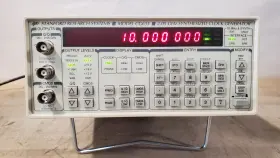
| Brand | STANFORD RESEARCH SYSTEMS |
|---|---|
| Manufacturer Part Number | CG635 |
| Part Type | CLOCK GENERATOR |
| Materials Sourced From | UNITED STATES |
Review STANFORD RESEARCH SYSTEMS 2.05 Ghz Synthesized Clock Generator Tested
The Stanford Research Industries (SRI) Model CG635 2.05 Synthesized Clock Generator is a versatile and high-performance clock generation solution designed for various applications in test and measurement, telecommunications, and other industries. This clock generator is part of SRI's extensive line of synthesized clock products and is based on the latest technology to deliver precise and stable clock signals.
At its core, the CG635 2.05 is a phase-locked loop (PLL) synthesizer that can generate single-ended or differential clock outputs with frequencies ranging from 1 Hz to 6.6 GHz. It features an integrated voltage-controlled oscillator (VCO) and a powerful digital signal processing (DSP) section to provide precise frequency and phase control. The DSP section supports various frequency multiplication and division ratios, as well as advanced features like phase noise reduction and frequency agility.
One of the key advantages of the CG635 2.05 is its excellent phase noise performance. The integrated VCO is designed for low phase noise, and the DSP section includes advanced phase noise reduction techniques to minimize jitter and improve clock signal quality. This makes the CG635 2.05 an ideal choice for applications where high-quality clock signals are essential, such as in high-speed data communication systems, test equipment, and scientific research instruments.
The CG635 2.05 offers various input and output options to accommodate a wide range of applications. It supports both 50 Ohm and 75 Ohm SMA connectors for input and output, as well as optional external reference input and output. The generator also features a built-in frequency counter for accurate frequency measurement and calibration.
The CG635 2.05 is designed for easy integration into various systems and is housed in a compact, half-rack 1U high enclosure. It is also fully remote-controllable via an Ethernet interface, making it convenient to configure and operate from a distance. The generator comes with comprehensive software for easy setup and control, as well as built-in factory calibration data for quick and accurate performance verification.
In summary, the Stanford Research Industries Model CG635 2.05 Synthesized Clock Generator is a high-performance and versatile clock generation solution designed for applications where precise and stable clock signals are essential. It offers excellent phase noise performance, a wide range of frequencies, and various input and output options, making it an ideal choice for test and measurement, telecommunications, and other industries. The generator's compact size, easy integration, and remote control capabilities make it a convenient and powerful tool for generating high-quality clock signals.
The Stanford Research Industries (SRI) CG635 2.05 synthesized clock generator is a high-performance clock distribution solution designed for use in testing and measurement applications. Here are some pros and cons to consider before making a purchase.
Pros:1. High Frequency Support: The CG635 2.05 can generate clocks up to 6.4 GHz, making it suitable for applications requiring high-frequency clock distribution.
2. Low Jitter: SRI's clock generators are known for their low jitter performance, which is crucial in many testing and measurement applications.
3. Flexible Configuration: The CG635 2.05 offers various output options, including LVPECL, HMCMS, and buffered and unbuffered LVDS, allowing users to choose the best output for their specific application.
4. Built-in Test Features: The clock generator includes built-in test features, such as frequency sweeping, phase noise measurement, and jitter measurement, which can save time and resources during system development and testing.
5. Compact Size: The CG635 2.05 is relatively small, making it easy to integrate into test systems and reducing overall system size and complexity.
Cons:1. Cost: The CG635 2.05 is a high-end clock generator, and its cost may be prohibitive for some applications.
2. Power Consumption: The clock generator consumes more power than some other clock distribution solutions, which could be a consideration for battery-powered applications or systems with power budget constraints.
3. Complexity: The CG635 2.05 has a high level of integration and flexibility, which can make it more complex to set up and configure than simpler clock distribution solutions.
In conclusion, the Stanford Research Industries CG635 2.05 synthesized clock generator offers high performance, low jitter, and flexible output options, making it an excellent choice for applications requiring high-frequency clock distribution with precise timing requirements. However, its cost and power consumption may be drawbacks for some users. Ultimately, the decision to purchase the CG635 2.05 depends on the specific requirements of your application, the resources available, and the trade-offs you are willing to make.
If your application demands high-performance clock distribution with precise timing requirements, the CG635 2.05 is a strong recommendation. However, if cost or power consumption is a major concern, you may want to consider alternative clock distribution solutions that offer similar performance but at a lower cost or power consumption.
Details:
Tested working by our technician.
specifications busitestercalib:
- brand: Stanford Research Systems
- mpn: Cg635
- part type: Clock Generator
- materials sourced from: United States
seller busitestercalib:
- # reviews: 18327
- rating: 100.0%
- city: tucson, arizona
offer busitestercalib:
- in stock #: 5
- started: february 4, 2026
- best offers: true
- prices: $2500.00–$4130.00
- item condition:
- Used
- New – Open box
- Gebraucht
- options: ship-to-home
- availability: in stock
- sold #: 8
returns busitestercalib:
- paid by: buyer
- policy: returns accepted
- method: money back
- time: 30 days
shipping busitestercalib:
- service: standard
- type: fixed
- class: standard
- transit: 3-9 days
payments busitestercalib:
- credit card: discover
- other
- wallet: apple-pay
general busitestercalib:
- category: Business & Industrial > Test, Measurement Inspection > Testers Calibrators